
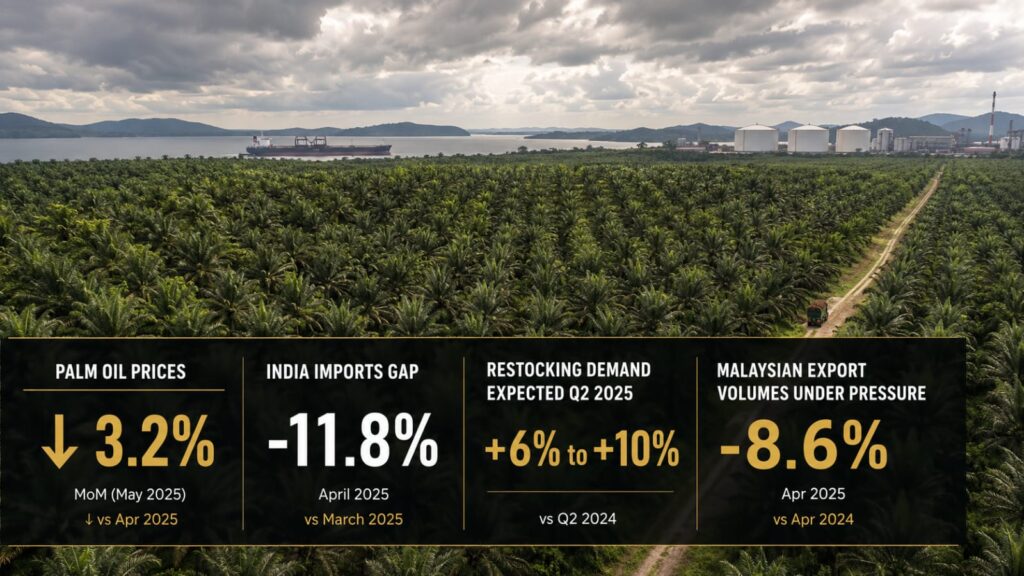
1. The Price Move: A 1.5% Drop Takes Palm Oil Near a One-Month Low
Malaysian palm oil futures fell approximately 1.5% during the week, pushing prices below MYR 4,450 per tonne and settling near their lowest level in almost a month. The decline is part of a broader softening trend that has gathered pace through early May, reflecting a confluence of currency, demand, and market sentiment pressures.
The move was not driven by a single factor but by several bearish signals aligning at the same time — a combination that tends to accelerate price corrections in commodity markets where sentiment can shift quickly.
2. What Drove the Decline: Currency, Competing Oils, and China’s Demand Outlook
Three interconnected pressures pushed palm oil prices lower this week. First, a strengthening Malaysian ringgit made palm oil more expensive for foreign buyers, reducing its price competitiveness on the international market. When the ringgit appreciates, buyers holding other currencies effectively pay more per tonne — a natural drag on export demand and, in turn, on futures prices.
Second, palm olein prices on China’s Dalian Commodity Exchange softened during the period, signalling weaker near-term demand from one of the world’s largest edible oil consumers. Dalian pricing is closely watched as a real-time indicator of Chinese buying appetite, and the decline added to the bearish tone in the broader palm complex.
Third, softer soybean oil prices on the Chicago Board of Trade placed additional downward pressure on palm oil. The two oils compete directly for market share in food manufacturing and biodiesel; when soybean oil becomes cheaper, palm oil must follow or risk losing buyers. This competitive dynamic remains one of the most important cross-commodity relationships in the global edible oils market.
3. China’s Reduced Soybean Import Forecast Weighs on Oilseed Sentiment
Market sentiment deteriorated further after China issued a forecast for lower soybean imports in the 2026/27 season. The downward revision reflects two structural shifts in China’s agricultural economy: weaker soymeal consumption and a shrinking domestic pig herd.
Soymeal is the primary protein feed for China’s hog industry. When pig numbers decline — whether due to disease, consolidation, or softer pork demand — feed requirements fall, and with them the need to import the soybeans from which soymeal is derived. Less soybean crushing also means less soybean oil as a by-product, which can indirectly affect demand for palm oil as an alternative.
For the wider oilseed market, China’s revised import outlook is a meaningful bearish signal. It suggests that global demand for vegetable oils — including palm — may face headwinds from the world’s largest importing nation in the year ahead.
4. Export Data: A Mixed Picture from Malaysia’s Early May Shipments
Export figures for the first half of May added to market uncertainty, with the two leading cargo surveying agencies reporting divergent results. AmSpec Agri Malaysia recorded palm oil exports down 10.8% compared to the same period last month, while Intertek Testing Services estimated exports up 8.5% over the same timeframe.
Such divergence between cargo surveyors is not unusual and often reflects differences in vessel coverage, timing of shipment recording, and methodology. However, the conflicting readings leave the market without a clear directional signal on near-term physical demand — which, in the current environment, contributes to price uncertainty rather than providing reassurance.
5. A Potential Floor: India’s Restocking Demand Could Limit Further Losses
Despite the broadly bearish tone, there is one factor that may prevent a deeper sell-off: the prospect of restocking demand from India. Indian palm oil imports fell sharply in April, creating a supply gap that will need to be replenished. Market participants broadly expect India to step up purchases in the near term, which would provide a demand-side buffer and limit how far prices can fall before buyers are incentivised to act.
India is one of the world’s largest importers of palm oil, and its buying decisions have an outsized influence on Malaysian and Indonesian export volumes. A return of Indian demand — even at modest levels — tends to be a stabilising force in the palm oil market, particularly during periods of price weakness when the economics of importing become more attractive.
For B2B buyers, the current price environment and the expectation of Indian restocking activity could represent a window of opportunity to review procurement positions ahead of what may be a short-term stabilisation in prices.